I walked into a restaurant because I was hungry. That was the entire plan. I wasn’t looking to download software, create an account, verify my email address, accept cookies, or join a rewards program. I wanted a cheeseburger. But QR code menus were about to introduce themselves in a major way.
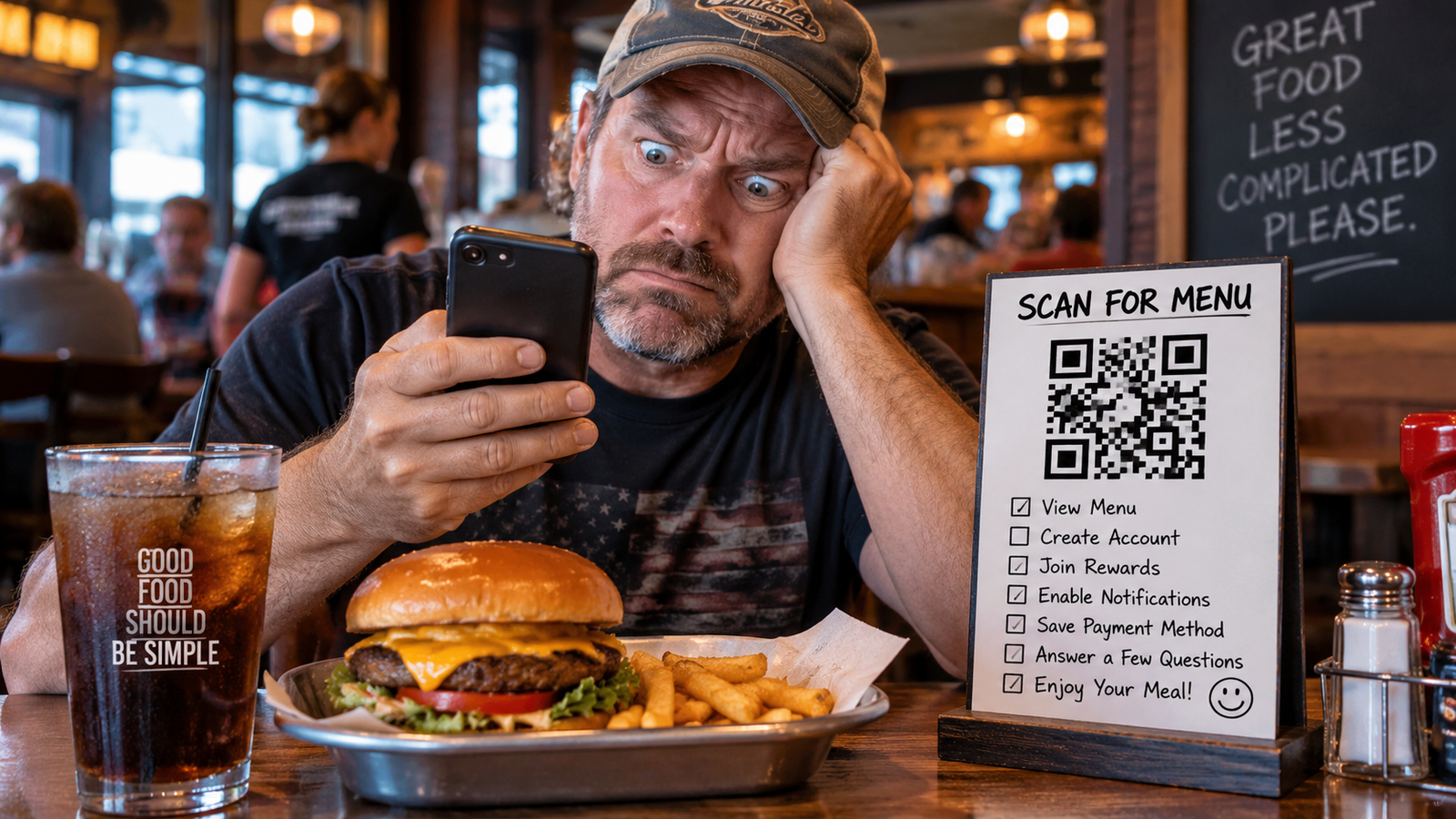
When I sat down, I realized there wasn’t a menu. There was a square. A tiny black-and-white square sitting on the table like it had no need to announce itself. The assumption is that everyone in the world just automatically knows what it is and why it’s there. The server had to point and explain that they have QR code menus.
Fine. I pulled out my phone and pointed it at the square. Suddenly I was using the same piece of technology that gets me onto an airplane just to find out what kind of cheese I can choose for my cheeseburger. Somewhere along the way, going out to eat became a technological burden.
First, the restaurant wants to know whether I’ll accept cookies. That struck me as odd. I’m sitting in a building that literally sells food, and somehow the first cookies I’m offered are the ones I can’t eat.
Then the website wants to know my location. You’re looking at me. I’m sitting at a booth by the window. If your computer needs more information than that to figure out where I am, we already have problems.
Would I like to receive notifications? Notifications about what? There is absolutely nothing this restaurant needs to tell me after I leave. If the chef comes up with a new way to put bacon on something, I’ll find out next time. I don’t need breaking news about a cheeseburger.
Then comes the app. Apparently, some restaurants have decided their food is important enough to deserve permanent real estate on my phone. Download our app and receive 200 bonus points. I don’t want points. I want lunch. But if you accumulate 10,000 points, you get a free shake. I don’t think I’m going to be eating here that much.
I remember when restaurants had menus. That was top-notch technology. You picked one up, opened it, and there was the food. No battery required. Nobody needed my email address. Nobody asked me to choose a password containing one capital letter, one number, and the blood type of my first pet.
You could even hand the menu to someone else. Try that with your QR code menus. Now everybody at the table is staring at their own phone. Nobody is talking because we’re all scrolling through seventeen categories trying to find sandwiches. Going to lunch with friends has somehow become four people independently browsing the same website.
Eventually I find the cheeseburger. There it is. I knew we’d find each other.
I order it. I eat it. For a glorious few minutes, technology leaves me alone. I’m sitting in a restaurant doing what humans have been doing for thousands of years. Eating food and wondering whether I should get another order of fries.
Then it’s time to pay. Another QR code. Of course. There’s a QR code on the receipt and QR code menus on the windows. It’s like a five-year-old discovering crayons for the first time.
I scan the square again. Now it wants my credit card information, phone number, and email address. Would I like to save my payment method for next time? Would I like to join the rewards program? Would I like a receipt emailed to me? Would I like to answer three quick questions about my experience?
No. I would like to go home. Then the tipping screen appears. The machine spins around and presents me with several enormous buttons while another human being stands three feet away pretending not to watch.
Twenty percent. Twenty-five percent. Thirty percent. Custom. Suddenly I’m taking the SAT with somebody staring over my shoulder. I remember when tipping was fifteen percent. The wait staff was happy with those numbers.
I make my selection, hit another button, and finally receive confirmation that I’m done. Congratulations! I have completed the transaction of eating a cheeseburger. At this point, I’m afraid to stand up. There may be an exit code. This technology is made for their convenience. Not the customer’s.
These are the main issues I see with this whole new trend. It’s certainly not catering to an older crowd who aren’t as technologically savvy. And what happens if my battery is dead? I can’t eat? I have to go somewhere else where they live back in the 1900s?