When Chaos Industries exploded onto the defense scene with its “coherent distributed networks” and anti-jamming radar tech, investors cheered. Governments lined up. Stock photos of people shaking hands filled PowerPoint slides everywhere.
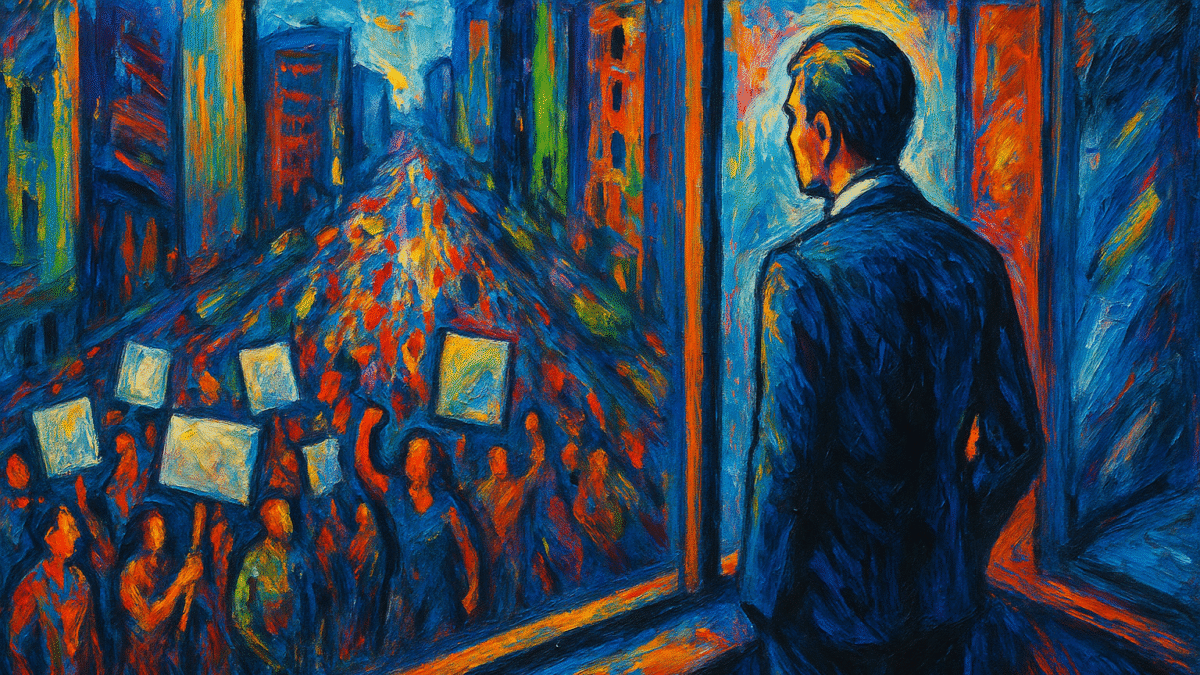
But inside the shiny, sensor-filled headquarters of Chaos, one executive stared out a window, looking down on the world far below his feet. Trent Voss was the VP of Disruption, an amateur drone pilot and self-described “visionary of inconvenience.” He was standing on a pile of money, but his heart was empty. It was as if what he had just wasn’t enough.
Somewhere between the third espresso and the fifteenth quarterly bonus, a thought began to take shape. There was a gap in the chaos market that no one else could see. High up in his ivory tower, he could see that protests were missing the drama they needed to make headlines, people online weren’t arguing enough to stir up entertainment, and life had become too calm to be profitable.
Who cares that the people want peace? Peace doesn’t make money!
That’s when Trent had his epiphany. If Chaos Industries specialized in defense, he would specialize in offense. Thus began the birth of FUBAR Technologies, a company dedicated to turning mild inconveniences into scalable disasters.
He didn’t pitch his idea to anyone. Not his team. Not his investors. Not even his therapist, who was already concerned about the “Disruption Vision Board” hanging in his office. Instead, he went home, locked the door to his study, and began sketching out a plan between a Word document and a spreadsheet. His plan included bankrolling the whole thing himself until the right kind of people started to reach out.
It was risky. It was reckless. It was pure Trent Voss. And for the first time in years, he felt alive.
Like a mad scientist, Trent mapped out ideas on grease boards and then erased ideas as he refined them. He drew pictures and wrote notes upon notes. He went through a whole box of markers and even felt the intoxicating effect of the ink. But he took a break, grabbed some fans, and opened windows to make sure his thinking didn’t go off into hallucinations when he was supposed to be creating ways to be the most disruptive.

His first idea took flight when he came up with noisemakers. Organic Rage Units often get out there with megaphones and amplifiers to blast their voices through a microphone. If Trent was going to beat that, he was going to need annoying devices that trolls would actually enjoy using.
The first in the line of FUBAR Noisemakers was the Screaming Blaster. One push of a button and a high-frequency screech bellowed out of a metal horn, perfectly designed to withstand being stomped by frustrated Drama Miners. Its metallic design also amplified the sound with an added annoying tint. Those babies flew off the shelves as soon as they hit Amazon because they were marketed so well to protestors of protests, “Stop those annoying pests from crying about their issues. The Screaming Blaster will make their ears bleed.”
Nothing more needed to be said. But Trent knew he was going to have to do better than that. So, he kept going with a complete line of noisemakers, each one considerably worse than the one before it. When he tested the Shrieking Destroyer, it made glass break. His neighbor suffered ear damage, and that’s when he knew he had effectively achieved the goal of creating the perfect silencer. Odd how the most effective silencer had to be so loud.
With money rolling in from the noisemaker line, he was back to the drawing board to invent his next brainchild. It would be a program that created fake social media accounts for the purpose of attacking a post and blasting it with comments. It was a simple plug-and-play code that any Thread Goblin could use to whip up thousands of profiles with fake pictures, background stories, and even hundreds of up-to-date posts to make it look real. Then, all the EchoBugs had to do was point and click at a post they wanted buried in tomfoolery.
Karens from all walks of life were practically throwing their credit cards at Trent because they were tired of all these perfectly logical arguments going viral and distracting everyone from the false narratives they were trying to create. There was nothing more annoying than fighting for something they desperately wanted Conflict Catalysts to believe, only to have some self-righteous do-gooder come along and spoil everything with facts. And that’s how the highly popular EchoFarm was created.
Of course, FUBAR would not be true to its name if it didn’t have the SpinCycle. Snark Farmers simply typed the misinformation into the form and named a celebrity or an expert in the field, then let the program go to work. Within a few hours, headlines were appearing all over the search engines and social media. It was glorious the way it worked so fast.
To polish off his efforts, Trent created several websites with similar names to top education and government agencies. The sites were magically designed to show years of service and made to look like they were award-winning for their achievements in creating social awareness and bringing truth to a world sinking in deception. Imagine that!
Those sites published brochures and gave the Outrage Choir talking points to spread across the internet so they could start perpetuating the lies themselves. This effort was founded on the fact that if he fueled the right suspicions at the right time, good Hashtag Soldiers would carry the misinformation themselves to their viral glory.
What was even more beautiful was that by the time the truth came out, the world would have already moved on. The truth is so hard to find and prove that lies could easily be pushed and believed. And by nature of the human being, once a belief is embedded into a person’s psyche, it’s nearly impossible to dislodge it. So, the poor Engagement Assets would go on in life believing the lie long after the truth came to light, and no one cared at that point.
What a better world it all made for Trent. Of course, it wasn’t such a great world on the streets far below his office window. But why would he care about any of that? He could sit on top of everyone, watching as they burned each other alive over nothing. It was better than TV. So, he popped some popcorn and pulled up a seat, where he was able to watch all this taking place on the other side of his tinted bulletproof glass.
Michael Allen’s children’s book was originally written 20 years ago. To honor it on its anniversary, When You Miss Me is revisiting Krista’s past and bringing the story back to life in When You Miss Me Revisited – Wrapper Hammock.
To learn more about the books that inspired it, follow When You Miss Me or A River in the Ocean.